
It’s official: This week marked the beginning of summer! Summertime means more time for outside play, and when children go outside they naturally want to move—and not just move, but run and run! Running is a fundamental motor skill that helps children move from one place to another. Once children learn how to crawl, creep and walk, running naturally follows in the developmental order of learning locomotor skills. And when children discover that they can run, they usually can’t get enough of it.
Running’s benefits include the promotion of gross motor skills, vigorous physical activity, and the development of the components of health-related physical fitness--muscular strength and endurance, flexibility and cardiovascular endurance. Here are some activities that will get you off to a running start in helping children in your classroom or home to master movement:
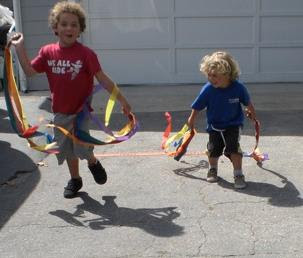
Run Like the Wind
Set up boundaries using
ropes or the
Start to Finish Lines 15’-24’ apart. Have children run from one line or boundary to another holding a
crepe paper streamer,
scarf or
Rainbow Dancing Wrist Band. They will automatically return to the start line and ask to do it again and again!
Flying Paper Plates & NewspapersSet up boundaries using
ropes or the
Start to Finish lines 15’-24’ apart. Have children place a
paper plates or sheet of newsprint (9” x 12”) or newspaper (11” x 12”) on their chest and start running. As they run faster and faster they will discover that the newspaper or plate will stick to their chest... a lesson in science, too! Another option is to put a
paper plates on the palm of each hand and start running to see what happens.
Run & RollSet up boundaries using
ropes or the
Start to Finish lines 15’-24’ apart. Place a
tumbling mat or
playmat a few feet in front of the finish line. When you say, “Get ready, get set, run,” the child at the “start line” runs to the mat and falls, rolls or tumbles to a stop. Without even directing children to the start of the running course, they will be in line just panting and waiting for another turn to “Run and Roll.”
Non-Competitive Red Rover, Red RoverSet up boundaries using
ropes or the
Start to Finish lines 15’-24’ apart. Two people at the finish line hold a sheet of newspaper (~ 22” x 24”) with two hands on each corner. When you say, “Get ready, get set, run,” the child at the “start line” (with the palms of his hands touching and pointing forward) runs and bursts through the newspaper!
 Tails
TailsSet up boundaries using
ropes or
cones in the available space. Each child tucks a
scarf or
Rainbow Dancing Wrist Band ribbon into their waistband behind their back. The
scarf or ribbon is now their “tail.” The game starts when the music starts and the children run in the available space. The game is played like tag, but instead of tagging each other, children pull the
scarves or ribbons out of others’ waistbands and drop them on the ground. The child whose
scarf or ribbon is pulled, picks up his
scarf (tail), goes to “the tail repair area” (a designated spot, such as a classroom door, tree, etc.) to replace the
scarf in their waistband. Once the
scarf is secure in their waistband, the child returns to the game and resumes pulling “tails.” The game ends when the music stops. This group game promotes cooperative play, vigorous physical activity and offers lots of laughter!


